Down The Road has been completely redesigned from the ground up — and packed with powerful new tools for serious genealogy research. Here is everything that is new.
It has been a busy few weeks behind the scenes, and today I'm thrilled to share the biggest update Down The Road has ever had. This isn't just a lick of paint — it's a ground-up rethink of what this site can be for Irish genealogy researchers.
Let me walk you through everything that's new.
A Fresh New Design
The first thing you'll notice is that Down The Road looks different. The entire interface has been rebuilt with a cleaner, more modern design system. We've moved to a warm parchment-toned palette with rich Celtic greens, better typography using Inter and Source Serif, and a card-based layout that makes dense genealogical data easier to read and navigate.
The navigation has been streamlined into a sticky header that stays with you as you scroll. Every page — from census search results to county profiles to individual person records — has been redesigned for clarity and consistency. It's faster, sharper, and much more pleasant to spend hours in (which, let's be honest, is what happens when you start digging into your family history).
Mobile support has been completely overhauled too. The site now works beautifully on phones and tablets, so you can research on the go or share a screen with family members without squinting.
Research Projects
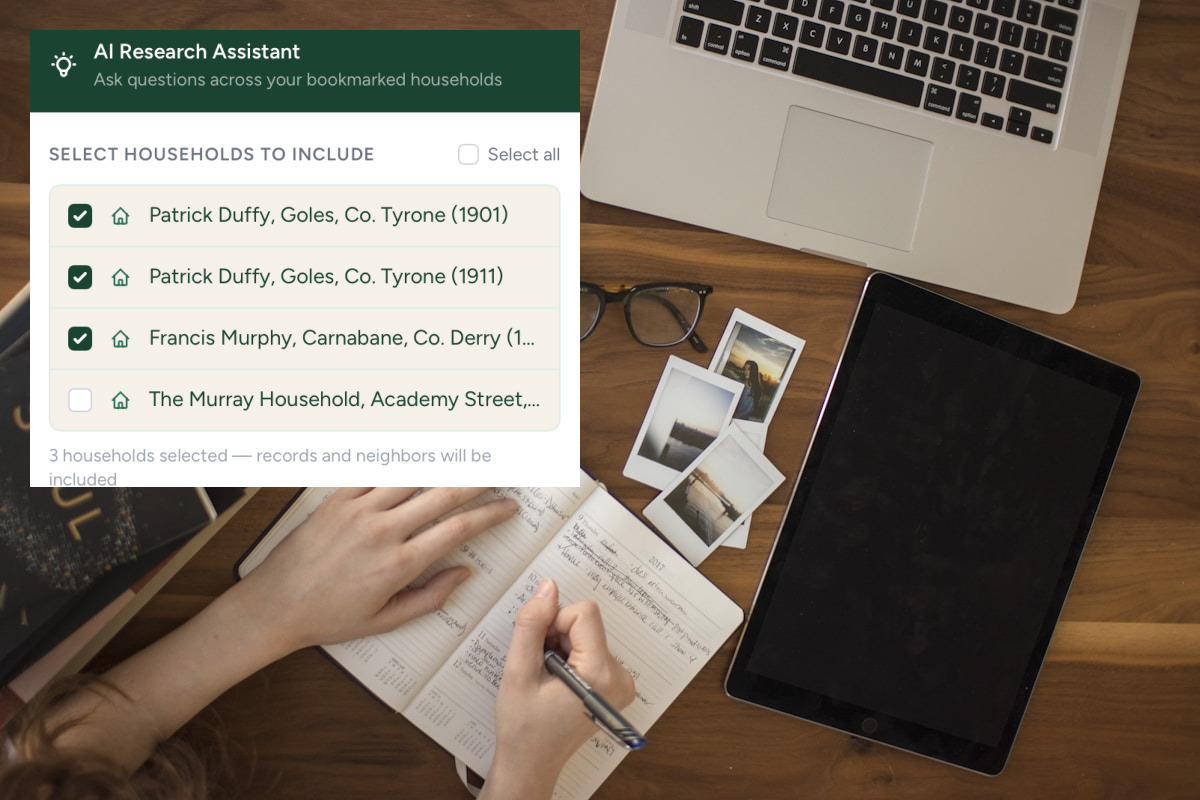
This is the headline feature. You can now create Research Projects to organise your genealogy work into separate, focused workspaces.
Each project is its own self-contained research hub. You can:
- Name and colour-code your projects to keep different family lines or research threads distinct
- Save bookmarks — star any county, townland, household, or person and they'll be saved to your active project
- Write research notes to keep track of your findings, theories, and next steps
- Add family members with photos and relationship details
- Upload DNA kits and run matches within the context of a specific project
- Import family trees from GEDCOM files
- Share your project as a public clan website (more on that below)
Think of it as your own private research desk — one for the Duffys, one for the O'Neills, one for that mysterious great-grandmother nobody can quite place.
DNA Upload & Matching
Down The Road now supports raw DNA file uploads from all major testing companies. Upload your DNA data file (TXT, TSV, CSV, or ZIP — up to 66 MB) and the site will parse it, count your SNPs, and identify the source format automatically.
Once your kit is uploaded, you can opt in to the DNA matching pool. The matching engine compares your data against other users in the pool and reports:
- Shared DNA segments with centimorgans (cM) and segment counts
- Estimated relationships based on the amount of shared DNA
- A chromosome browser that visually paints where your DNA overlaps with a match
- Surname clustering to spot patterns across your matches
- Haplogroup assignment and ancestry composition estimates
You can upload multiple kits — your own and those of family members — and compare them side by side using the multi-compare tool. There's also a leaderboard showing your top matches and the ability to add match notes so you can track what you've learned about each connection.
Every match can be linked back to census records on the site, bridging the gap between your DNA results and the historical record.
Family Tree Builder with GEDCOM Upload
You can now upload GEDCOM files (the standard family tree format used by every major genealogy platform) directly into your research project. The parser handles .ged files up to 50 MB and automatically extracts:
- Individuals with names, birth dates, death dates, and locations
- Marriages and family unions
- Parent-child relationships
Once imported, your tree is browsable through an interactive tree browser and a pedigree chart that visualises your ancestral lines up to four generations deep. You can set a root person to anchor the view, search across all names in the tree, and see a surname analysis of the most common family names.
Privacy is handled carefully — anyone in your tree without a recorded death date is displayed as Living to protect the privacy of potentially living relatives.
You can import multiple GEDCOM files per project if your research spans different branches, and control whether or not the tree is visible on your shared clan website.
Clan Website Builder
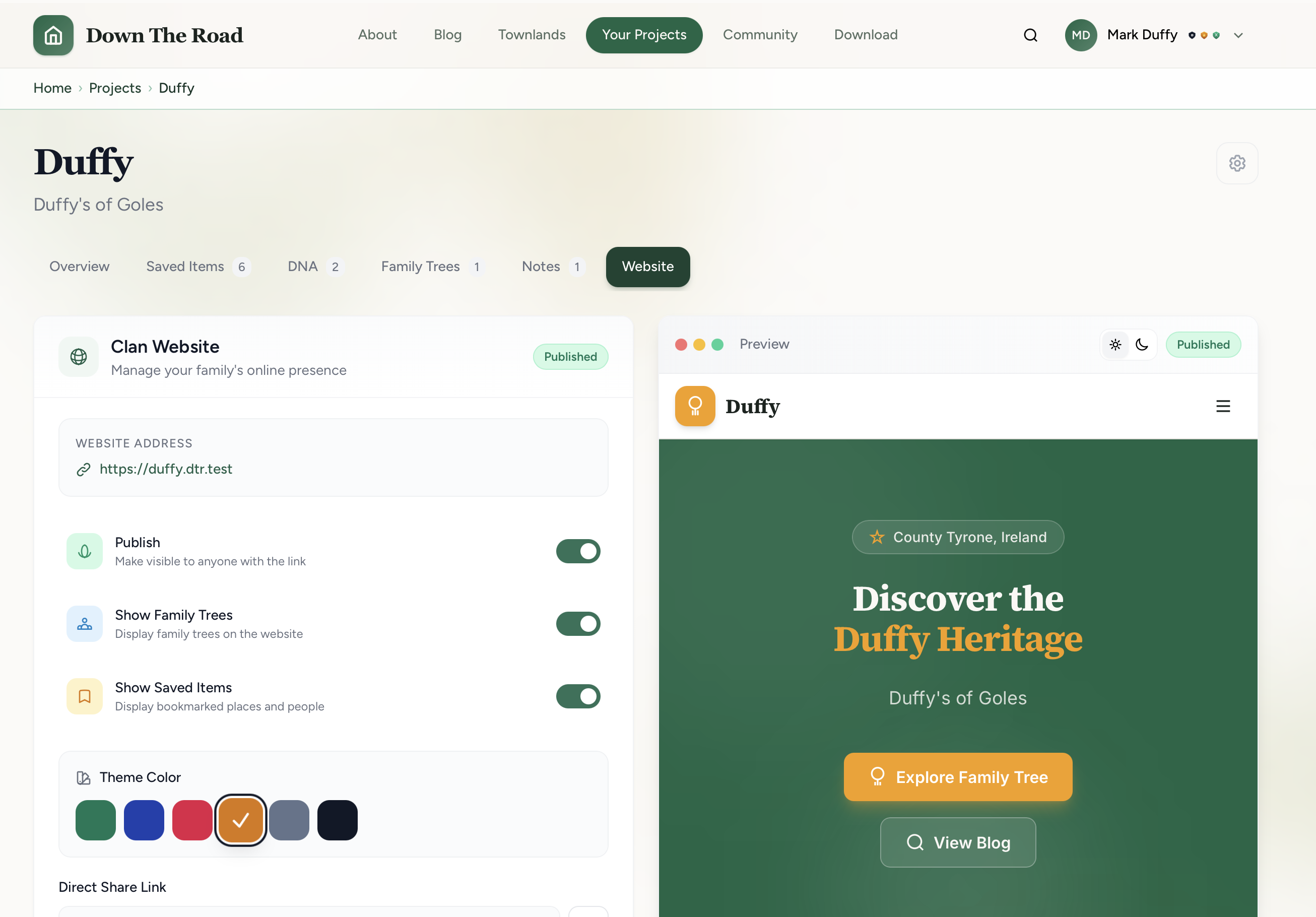
This is where it all comes together. Every research project can be published as a clan website — a public-facing site for your family, accessible at its own custom URL.
Your clan website includes:
- A home page with a welcome message and latest updates
- A family tree browser (if you choose to share it)
- A blog where you can write and publish posts about your research, family stories, or discoveries — with images, excerpts, and draft/published states
- A family events calendar for birthdays, anniversaries, reunions, and milestones
- Shared bookmarks so visitors can explore the census records you've found most interesting
- Member profiles for family members in the project
You can choose from six themes — Celtic, Navy, Rose, Amber, Slate, and Night — to give your site its own personality. The theme controls accent colours across buttons, links, icons, and interactive elements throughout the site.
Family members can be invited by email with role-based access. Admins can manage everything, editors can write blog posts and add events, and family members can browse, react, and comment.
It's essentially a mini family website that runs itself — no hosting, no setup, no technical knowledge required. Just fill it in and share the link with your relatives.
What's Next
This update lays the foundation for a lot of what's coming. Family trees that link directly to census records. Historical maps overlaid with townland data. Griffith's Valuation. Immigration records. The 1926 census (coming April 2026). And much more.
As always, Down The Road is built by one person in his spare time, and every feature you see was written one line at a time.
Thank you for being part of this. Now go create a project and start digging.
— Mark